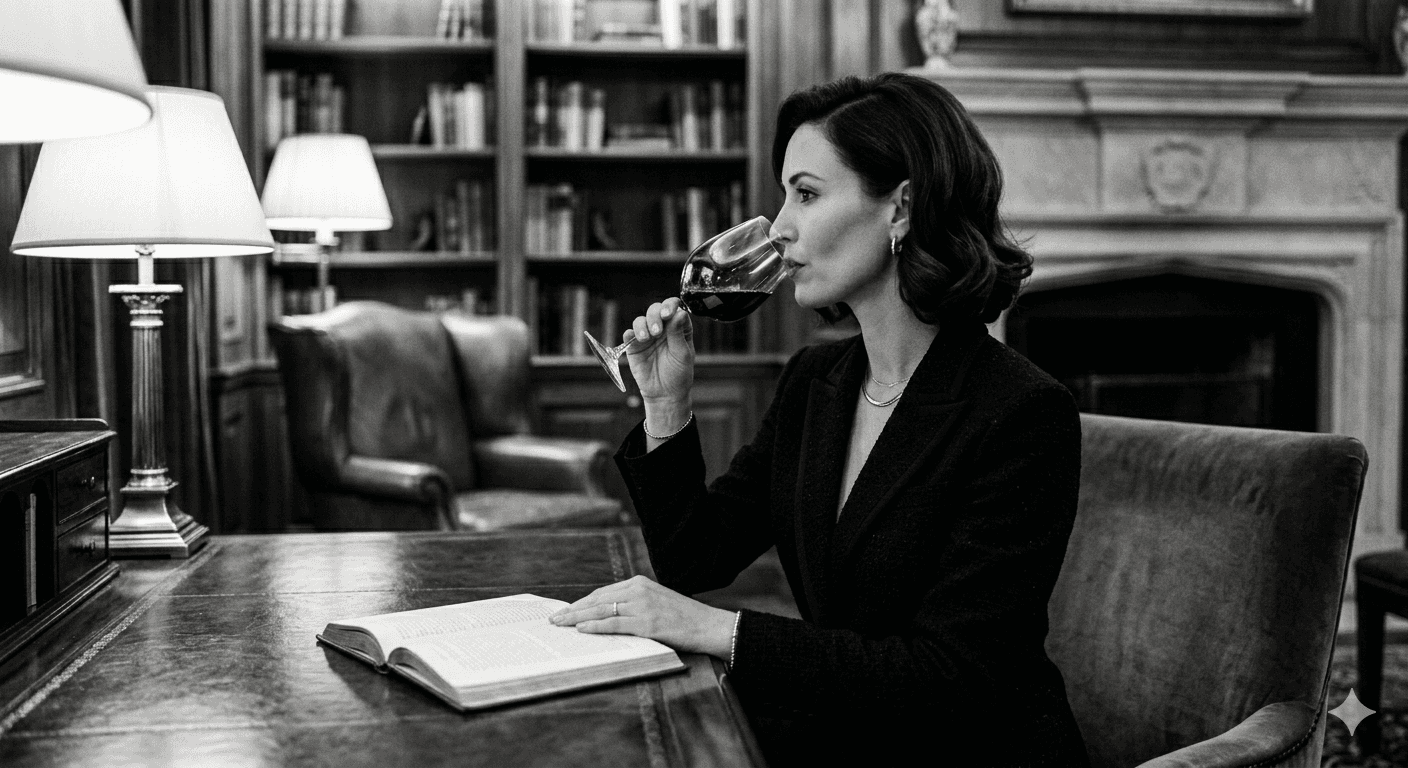
Picture a Tuesday evening. You've come home from work. You're cooking dinner alone, and you want a glass of something. The occasion is real, but it is quiet, it does not call for ceremony, does not require annotation, does not ask you to pay attention in any particular way.
You reach for a bottle. A full-bodied red at 14.5% feels misaligned with that moment, not wrong exactly, but heavy in a way that changes the evening rather than complementing it. The wine becomes the event. You wanted a companion; you got a statement.
"A lighter, better-calibrated version of the same wine, not a different wine, not a lesser wine, but the same winemaker's intent expressed at a lower register, fits naturally."
This is what harmony in wine actually looks like. Not a grand philosophy. Not a rejection of the traditions that have shaped viticulture for centuries. Something far more practical, and in its own way, far more radical: wine that calibrates itself to the life it enters, rather than demanding that life calibrate itself to the wine.
The Nature of Fit
When a wine knows its moment
There is a longstanding assumption baked into how wine is made and marketed: that more is more. More body. More tannin. More alcohol. More concentration. These qualities are treated as virtues in themselves, independent of context. The 100-point score imagines an ideal wine that exists outside of any particular evening, any particular hunger, any particular mood.
But wine is not consumed in a vacuum. It is consumed in kitchens and on patios, at dinner tables and on sofas. It is consumed by people who are tired and people who are celebratory, by people eating roast lamb and by people eating pasta with olive oil. Context is not incidental to wine, context is everything. A wine that ignores its context does not transcend it. It simply misses.
Harmony, then, is not a soft quality. It is not the absence of character. It is the presence of the right character, calibrated to the right moment. A wine in harmony with its occasion neither overwhelms it nor disappears into it. It belongs.
The ALTR Approach
Same intent, lower register
This is the premise that drives ALTR. The innovation is not in the vineyard, exactly, nor in the cellar in any conventional sense. It is in the recognition that winemaker intent (the vision of what a wine should taste like, feel like, express) can be preserved even as its alcohol is reduced. The soul of the wine need not be sacrificed at the altar of lower ABV.
What ALTR offers is precisely that: the same wine, differently calibrated. The aromatics of a Shiraz, the structure of a Cabernet, the freshness of a Pinot Gris, these remain intact. What changes is the weight, the warmth, the way the wine sits in the body after the glass is empty. You can have a second glass. You can have dinner. You can be present for the evening.
"Not a revolution in winemaking philosophy. Not a rejection of tradition. Simply this: wine that fits into life as it is actually lived."
The technical challenge of achieving this is significant. Removing alcohol from wine without stripping its character requires precision at every stage, from fermentation management to the careful application of dealcoholisation technology that protects volatile aromatics. The result should be indistinguishable in intention from its full-strength counterpart, even if it lands differently in the glass.
ALTR has approached this as a craft problem, not a compromise. The question is never "how little can we get away with?" but rather "how faithfully can we translate this wine's identity into a form that serves more occasions?"
A Broader Shift
The most disruptive thing about a modest ambition
The wine industry is not known for swift adaptation. Its rhythms are seasonal, its traditions deep, its gatekeepers numerous. Grand claims are common; meaningful change is slow. Against this backdrop, ALTR's pitch is deliberately understated: wine that fits more moments. Wine for a Tuesday evening.
And yet that modesty is deceptive. Because to say that wine should fit life, rather than defining it, performing for it, or asking it to slow down, is to challenge something foundational about how wine culture has understood itself. It is to say that the quiet occasion is as worthy as the grand one. That the everyday drinker's needs are as legitimate as the collector's. That accessibility is not dilution.
There is a growing cohort of drinkers who have been moving in this direction for years, reducing alcohol for health reasons, for pregnancy, for the simple pleasure of moderation, and who have done so by choosing not to drink wine, because wine did not meet them where they were. ALTR is an argument that it can. That it should.
In an industry prone to grand claims and slow change, that modest ambition might be the most disruptive pitch of all. The Tuesday evening is always there. The question is whether the wine will show up for it.